
Project Details
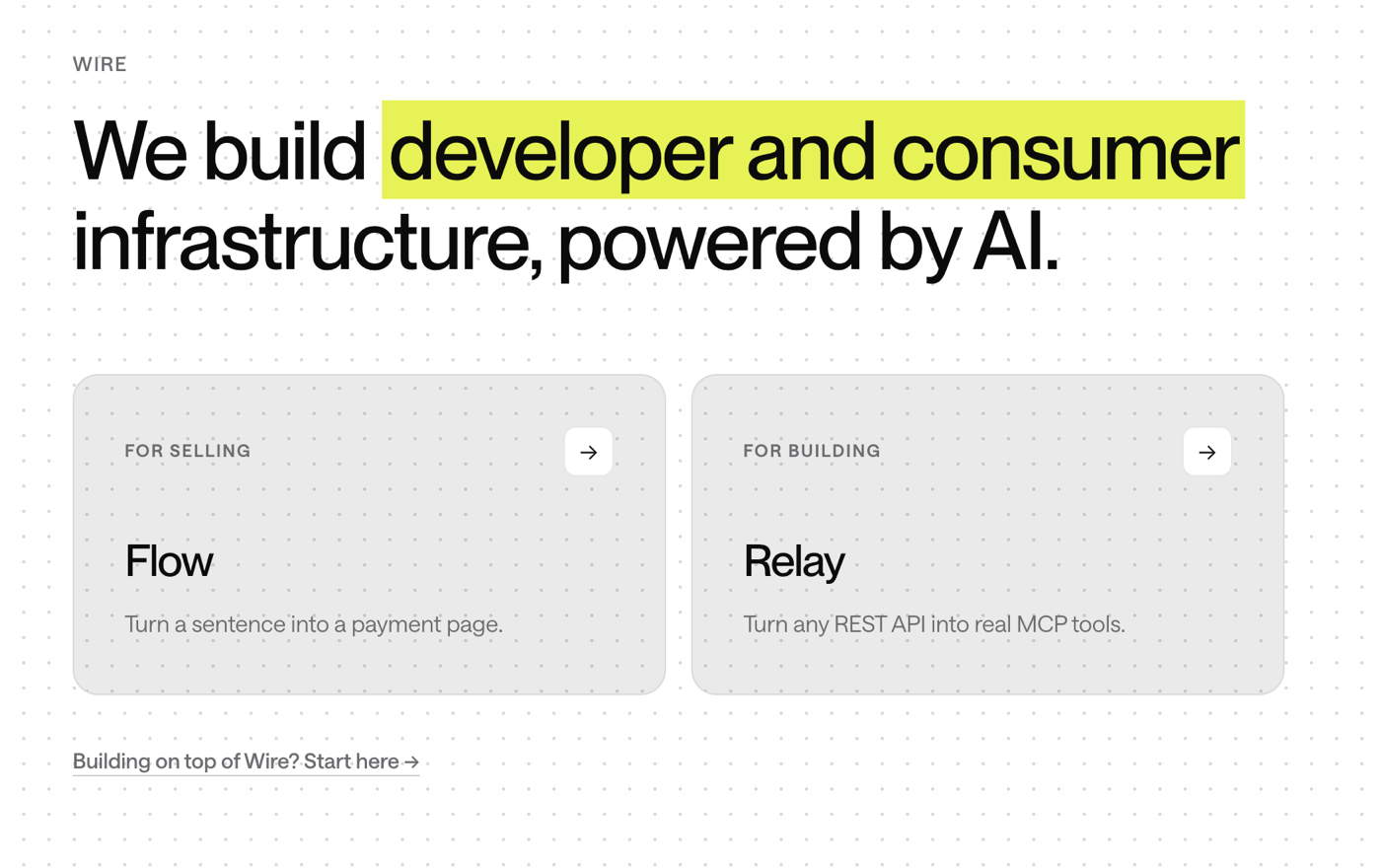
Wire is developer and consumer infrastructure powered by AI. Two products sit on top of one engine, and the engine is the whole idea: compile an API description into a typed, callable tool, then let an agent decide when to call it.
Flow — a sentence to a payment page
A seller describes a sale in plain English — “sell tickets, ₦5,000, cap 100” — on the web or by messaging Wire on WhatsApp. An OpenAI agent parses it, decides between a single price, tiered pricing or a recurring subscription, and calls Paystack’s API as tools to create the reserved account and invoice. Seconds later the seller has a checkout link, a QR code and a live sales dashboard.
Paystack’s webhook confirms each payment over an HMAC-verified channel, and recurring Flows re-charge themselves from a daily cron using the card token captured on the subscriber’s first payment.
Relay — any API, as MCP tools
The same compiler, exposed directly. Paste a raw curl command or an OpenAPI spec and Wire spins up a live Model Context Protocol server that Claude Desktop, Cursor or a custom agent can connect to and call — no hand-written tool schemas.
Connect — bring your own system
Sellers can attach a tool they already use (Airtable, Notion, anything with an API). Wire’s gateway compiler turns whatever they paste into a typed tool list, and when a sale lands a small agent runs against those tools to do the obvious thing: decrement stock, log a row. It’s explicitly allowed to do nothing if nothing fits — which turned out to be the hardest part of the prompt to get right.
What I built
- The full Next.js 16 app on the App Router with React 19 and Tailwind CSS v4
- The gateway compiler —
curland OpenAPI parsers that emit Zod-validated, typed tool definitions - The MCP server generation layer, served per-gateway and callable by any MCP client
- The OpenAI agent loop on the Responses API, including the Paystack tool set
- The conversational WhatsApp surface over Twilio, QR codes returned as follow-up images
- Checkout, the live seller dashboard, and HMAC-verified Paystack webhook handling
- Recurring billing with card tokenization, driven by Vercel Cron
Notes
Judges reviewing an earlier build called it “genuinely solid across the board” and one of the more complete submissions in its batch, singling out the third-party integration as solving the real problem rather than demoing it.
The brand is deliberately light-mode only: editorial whitespace, hairline borders instead of shadows, dotted grids behind product surfaces, and exactly one loud accent per view.